
Haughton Design supports medical device, MedTech and pharmaceutical teams with pre-verification engineering activities that reduce development uncertainty before committing to formal Design Verification Testing (DVT). By combining practical bench testing, bespoke fixtures, Design of Experiments (DoE) and FEA-led simulation, we help teams understand how devices behave earlier in development and use that evidence to guide design decisions.
Our approach is particularly valuable when a product is still evolving, requirements are being refined, or physical prototypes are limited. We can help create engineering evidence, simulation models and digital twins that allow design teams to explore load cases, mechanisms, failure modes and performance sensitivities before expensive tooling, production-equivalent samples or formal verification programmes are required.
One of the strongest ways to de-risk early development is to combine physical testing with simulation. Physical tests provide real-world behaviour, material response and mechanism data, while FEA and simulation allow the design space to be explored more quickly than physical prototyping alone.
By using test data to inform and correlate simulation models, we can help create practical digital twins of components, mechanisms or device sub-systems. These models can then be used to investigate stress, deflection, actuation forces, tolerance sensitivity, material behaviour and design robustness across a wider range of conditions quicker than would typically be possible through physical testing alone.
This supports faster iteration and more informed design reviews, helping teams understand not just whether a concept works, but why it works, where it may fail and which design changes are most likely to improve performance.

If you want to reduce development risk before formal verification, talk to Haughton Design. We can help you combine early-stage testing, FEA and digital twin development to make better design decisions, reduce prototype loops and build confidence in your device before committing to the next stage.
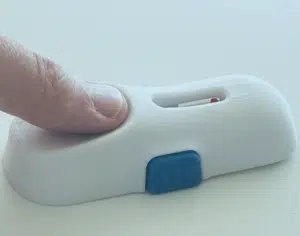
Early prototyping and user testing catch usability issues before costly mistakes, creating safer, smarter medical devices for users.

HD developed an auto-injector training device, utilising key skillsets from conceptual development and FEA, prototyping and DFM

HD provided the full characterisation and reverse engineering of a range of multi-dose syringes for an undisclosed client. Thorough reverse engineering, prototype supply and a manufacturing data pack was delivered, together with additional design improvements...

HD provided our client with a highly cost effective solution to their design challenges. Risk was significantly reduced by utilising HD’s medical device expertise, and the client was able to keep momentum by using HD.